
DSIP research compound refers to delta sleep-inducing peptide, a nine-amino-acid sequence first described in experimental sleep research during the 1970s. Scientists have examined DSIP in relation to electroencephalogram patterns, sleep architecture, neuroendocrine signalling, peptide stability and analytical identity. However, the literature remains limited, mechanistically uncertain and unsuitable for direct treatment claims.
This guide explains the original sequence, major research questions, conflicting findings, quality-testing requirements and Canadian regulatory context. It is written for qualified laboratory and educational use. It does not provide medical advice, human dosing, reconstitution instructions or directions for self-administration.
DSIP Research Compound: What Is DSIP?
Delta sleep-inducing peptide is a nonapeptide, which means that its chain contains nine amino-acid residues. The sequence reported in the original work is Trp-Ala-Gly-Gly-Asp-Ala-Ser-Gly-Glu, often written as WAGGDASGE. Early investigators isolated a peptide from rabbit cerebral venous blood dialysate and linked it with increased delta and spindle EEG activity in experimental models.
The name can sound more definitive than the evidence. DSIP is not an established sleep medication, and researchers have not confirmed a single receptor or complete mechanism that explains all reported observations. Therefore, accurate scientific writing should say that DSIP has been studied in sleep-related models rather than claiming that it treats insomnia or reliably induces sleep.
DSIP Research Compound: Quick Facts
- Full name: delta sleep-inducing peptide.
- Sequence: Trp-Ala-Gly-Gly-Asp-Ala-Ser-Gly-Glu, abbreviated WAGGDASGE.
- Length: nine amino-acid residues.
- Historical origin: experimental rabbit EEG and cerebral venous blood dialysate research published in the 1970s.
- Research areas: EEG patterns, sleep architecture, neuroendocrine endpoints, peptide analogs and analytical chemistry.
- Evidence status: small and mostly older studies, with mixed findings and major gaps in modern clinical validation.
- Canadian status: DSIP is not presented here as an authorized therapeutic product and is restricted to qualified laboratory research.
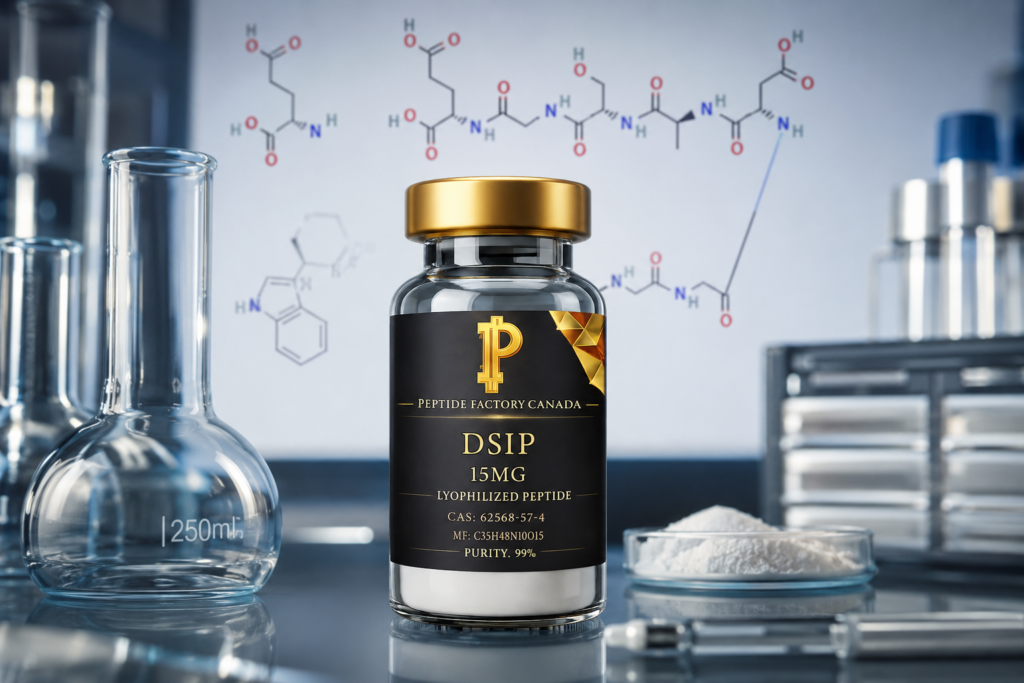
Discovery and Chemical Sequence
A 1977 report described a peptide associated with enhanced delta and spindle EEG patterns after experimental administration in rabbits. Follow-up work published in 1978 reported the amino-acid sequence, synthetic preparation and comparison with metabolites and analogs. In those experiments, the alpha-aspartyl form showed activity that the beta-Asp isomer did not reproduce.
That stereochemical result remains important for analytical research. A compound can have the expected nominal formula yet contain sequence, isomeric or degradation-related impurities that alter an assay. Consequently, laboratories need more than a product name or generic purity claim when they qualify a DSIP batch.
Later publications used terms such as “DSIP-like immunoreactivity” when an assay detected material that reacted with antibodies developed against DSIP. Immunoreactivity does not automatically prove that every measured signal represents intact WAGGDASGE. Researchers must consider antibody specificity, metabolites, cross-reactivity and matrix effects.
DSIP Research Compound: How Scientists Study It
Sleep-related DSIP studies have used EEG or polysomnography to measure objective stages and rhythms. Typical endpoints include total sleep time, sleep onset, sleep efficiency, stage distribution, delta activity, spindle activity and wakefulness. These measurements provide more information than a subjective statement that a subject appeared tired.
Neuroendocrine studies have examined hormones such as ACTH and cortisol, while other models have measured neurotransmitters, pineal indolamines or markers linked with neuronal signalling. In addition, analytical laboratories may study identity, chromatographic purity, degradation pathways, adsorption, aggregation and matrix recovery.
Each model answers a narrow question. An EEG change in rabbits cannot establish efficacy in people, and a biomarker result cannot prove a clinical benefit. Accordingly, researchers should define species, model, peptide form, route, analytical method and endpoint before comparing publications.
DSIP Research Compound: What the Evidence Shows
| Study | Model | Main research signal | Important limitation |
|---|---|---|---|
| 1977 characterization | Rabbits | Reported increased delta and spindle EEG patterns after experimental administration | Animal model and early discovery methods |
| 1978 sequence study | Rabbits | Compared synthetic DSIP, fragments and analogs; reported stereochemical specificity | Does not establish a human therapeutic effect |
| 1981 sleep study | Six healthy volunteers | Double-blind crossover study reported acute and delayed sleep-related changes | Extremely small sample and older methodology |
| 1994 Cushing syndrome study | Patients and controls | Measured sleep and DSIP-like immunoreactivity | Observed correlation argued against a simple causal link with delta sleep |
| 1995 endocrine study | Small groups of healthy men | Compared ACTH and cortisol responses with placebo | Did not support the proposed inhibitory endocrine role |
| 2018 phosphorylated-DSIP study | Rats under simulated high-altitude hypoxia | Reported changes in sleep architecture and memory-related endpoints | Modified peptide, animal model and specialized condition |
| 2024 DSIP fusion-peptide study | Mouse insomnia model | Examined neurotransmitters and sleep-related behaviour | Fusion construct is not native DSIP and cannot establish human efficacy |
The table shows why a balanced evidence review matters. Some early studies reported signals, while later work challenged simplified explanations or tested chemically different constructs. A credible DSIP research compound article should include both positive and negative findings.
DSIP Research Compound: Sleep Research Limitations
The early human literature includes small controlled studies, but sample sizes were far below what researchers now expect for dependable clinical conclusions. Study populations, methods and reporting standards also differ from modern large randomized trials. As a result, these publications remain historically interesting rather than proof of an approved sleep therapy.
Sleep itself is multidimensional. A change in delta EEG activity does not necessarily mean better daytime function, improved long-term health or treatment of a sleep disorder. Researchers should separate electrophysiological signals from subjective sleep quality, clinical outcomes and safety.
Replication also matters. Before a claim becomes reliable, independent teams should reproduce it with adequate controls, validated material, prespecified endpoints and transparent statistics. The DSIP literature does not support skipping those requirements.
DSIP Research Compound: Neuroendocrine Evidence
Researchers have proposed that DSIP may interact with stress-response or neuroendocrine systems. However, proposals are not confirmed mechanisms. For example, a 1995 human study found nearly identical ACTH and cortisol responses during DSIP and placebo conditions after defined physiological challenges.
An earlier rat pineal-gland experiment reported changes in melatonin, serotonin and a related indolamine under ex vivo conditions. That experiment supports a laboratory question about pineal signalling, but it does not establish the same response in humans. Concentration, tissue preparation and species all affect interpretation.
Therefore, the most defensible conclusion is that DSIP has been investigated across several neuroendocrine endpoints with incomplete and sometimes conflicting results. Researchers should describe the exact endpoint rather than using a broad phrase such as “stress peptide” or “hormone regulator.”
DSIP Research Compound: Native DSIP vs. Modified Analogs
Native DSIP, phosphorylated DSIP and carrier-linked fusion peptides are different experimental materials. Adding a phosphate group or fusing DSIP with a protein-transduction or albumin-related domain can change molecular mass, stability, distribution and assay behaviour. Findings cannot be transferred automatically from one form to another.
Researchers should record the complete construct, terminal modifications, counterion, sequence and calculated molecular mass. Meanwhile, literature searches should distinguish WAGGDASGE from analogs, fragments and fusion proteins. This practice prevents an apparently broad evidence base from combining chemically non-equivalent compounds.
DSIP Research Compound: Quality Testing
High-performance liquid chromatography can separate DSIP from detectable impurities under a defined method. The chromatogram, column, gradient, wavelength, integration rules and reporting threshold influence the stated purity. Therefore, “99% purity” has little analytical value without method context and a batch identifier.
Mass spectrometry can compare observed mass-to-charge signals with the expected molecular mass. It complements chromatography because purity and identity are different questions. When stereochemical or sequence-related impurities are relevant, a laboratory may need an orthogonal or specially designed method rather than routine intact-mass analysis alone.
Depending on the protocol, additional attributes may include peptide content, water, counterions, residual solvents, elemental impurities, bioburden or endotoxin. Chromatographic purity does not prove sterility, and neither purity nor sterility establishes clinical safety. The experimental risk assessment should define which tests are necessary.
DSIP Research Compound: How to Read a COA
A certificate of analysis should summarize results for the specific batch supplied to a laboratory. Match the lot number on the document with the vial and investigate any inconsistency before use.
- Identity: complete compound name, sequence and modification state.
- Traceability: a batch or lot number that matches the received material.
- Mass evidence: calculated and observed molecular mass under a named method.
- Chromatography: reported purity, specification and representative chromatogram.
- Method details: enough information to understand how the result was produced.
- Test date: analysis date and a supported retest or expiry statement where applicable.
- Laboratory record: report number, testing organization and reviewer.
- Scope: clear separation between analytical results and attributes that were not tested.
A COA supports material qualification but does not replace a laboratory’s incoming controls. Moreover, a generic example COA cannot demonstrate the quality of every later production lot.
DSIP Research Compound: Laboratory Design Checklist
- Define a narrow hypothesis and prespecified primary endpoint.
- Confirm whether the material is native DSIP, an analog, a fragment or a fusion construct.
- Verify sequence identity and batch-specific chromatographic purity.
- Use positive, negative, vehicle and matrix controls appropriate to the assay.
- Evaluate solubility, nonspecific adsorption, aggregation and recovery.
- Document concentration calculations and instrument settings without converting research work into human dosing advice.
- Separate exploratory endpoints from confirmatory analysis.
- Retain raw spectra, chromatograms, deviations and storage records.
Qualified laboratories can review the DSIP 15 mg research material page and request batch documentation before procurement. They can also review the broader research peptide catalogue, the supplier’s quality approach, or contact technical support. Every institution should still complete its own supplier and protocol qualification.
DSIP Research Compound: Storage and Handling
Storage requirements depend on sequence, presentation, container closure and study duration. Laboratories should follow the batch documentation, safety data sheet and a validated internal procedure. Temperature excursions, moisture, light and repeated handling may affect integrity.
Before an experiment, define acceptance criteria for appearance, recovery, solubility and analytical stability. If a validated method supports aliquoting, it may reduce repeated handling or freeze–thaw exposure. In every case, analysts should record preparation dates, conditions and deviations.
This section intentionally excludes reconstitution recipes and dosing directions. Research procedures belong in approved institutional protocols, while medical questions belong with licensed healthcare professionals.
DSIP Research Compound: Canadian Regulatory Context
Health Canada identifies DSIP among injectable peptide products that may be sold online with unauthorized health or bodybuilding claims. The agency explains that injectable peptides are regulated as prescription drugs in Canada and warns about serious risks from unauthorized products.
Health Canada also states that “for research use only” wording does not make an unauthorized drug legal, safe or exempt from regulatory requirements. Consequently, consumers should not inject, ingest or otherwise self-administer DSIP research material. Products on this site are restricted to qualified laboratory work and are not approved treatments.
Laboratories should assess the requirements that apply to their institution, import route, material and intended experiment. This article offers general educational information, not legal advice. When the rules are unclear, consult institutional compliance staff or the relevant Canadian authority.
DSIP Research Compound FAQ
What does DSIP stand for?
DSIP stands for delta sleep-inducing peptide. The name came from early experiments that associated the peptide with delta and spindle EEG patterns.
What is the DSIP amino-acid sequence?
The reported native sequence is Trp-Ala-Gly-Gly-Asp-Ala-Ser-Gly-Glu, abbreviated WAGGDASGE. It contains nine amino-acid residues.
Is DSIP a nonapeptide?
Yes. “Nonapeptide” means a peptide made of nine amino-acid residues. The term describes chain length, not therapeutic status.
Is DSIP naturally occurring?
Early researchers reported isolating DSIP from rabbit cerebral venous blood dialysate, and later studies measured DSIP-like immunoreactivity. However, the identity, distribution and physiological role of endogenous DSIP remain more complex than the name suggests.
Does DSIP reliably induce sleep?
The evidence does not support that broad claim. Early animal work and very small human studies reported sleep-related signals, but the literature lacks modern large-scale validation needed for a dependable clinical conclusion.
Is the DSIP mechanism known?
No single confirmed receptor or complete mechanism explains all reported DSIP findings. Researchers have examined EEG, neuroendocrine and neurotransmitter endpoints, but uncertainty remains.
What is delta sleep?
Delta activity refers to low-frequency EEG waves commonly associated with deep non-REM sleep. A delta-wave change is an electrophysiological measurement and does not by itself prove treatment of a sleep disorder.
How do researchers measure DSIP-related sleep endpoints?
Researchers may use EEG or polysomnography to measure sleep onset, total sleep time, efficiency, stage distribution, delta power, spindle activity and awakenings. The protocol should prespecify the primary endpoint.
What is DSIP-like immunoreactivity?
It is an assay signal produced when antibodies recognize DSIP or related material in a sample. Cross-reactivity, fragments and metabolites can affect the result, so immunoreactivity is not always identical to confirmed intact peptide.
Did human DSIP studies include large samples?
No. Frequently cited human studies were small and mostly published decades ago. Their findings require cautious interpretation and should not be treated as modern clinical proof.
What did the 1995 ACTH and cortisol study find?
The investigators reported nearly identical ACTH and cortisol responses during DSIP and placebo conditions in small groups of healthy men. The results did not support the proposed inhibitory role in that model.
Is phosphorylated DSIP the same as native DSIP?
No. Phosphorylation changes the molecule and may alter stability, distribution or biological behaviour. Results from phosphorylated DSIP cannot be assigned automatically to native WAGGDASGE.
Are DSIP fusion peptides equivalent to DSIP?
No. A fusion peptide includes additional domains or sequences, which change its molecular properties. Researchers must identify the exact construct before comparing results.
Is DSIP approved by Health Canada?
DSIP research material is not presented as an authorized therapeutic product. Health Canada includes DSIP in warnings about unauthorized injectable peptide drugs and advises consumers not to use such products.
Can DSIP research material be injected or ingested?
No. Laboratory material is not for injection, ingestion, topical self-use or veterinary administration. Human use would fall outside the research-only purpose and may create serious health and regulatory risks.
Is DSIP a prescription sleep medicine?
No. A research reagent does not have the authorization, approved monograph or clinical evidence required for a prescription medicine. It must not substitute for professional diagnosis or treatment.
What should a DSIP certificate of analysis include?
Look for the exact sequence, batch number, observed molecular mass, chromatography result, methods, test date, specifications and testing-laboratory information. Match the report with the received vial.
Does HPLC purity confirm DSIP identity?
No. HPLC estimates chromatographic purity under a defined method. Mass spectrometry or another suitable identity method should support the expected molecular identity.
Why does DSIP stereochemistry matter?
The 1978 sequence study reported different experimental activity for alpha-aspartyl DSIP and its beta-Asp isomer. This illustrates how an isomeric impurity can matter even when overall composition appears similar.
Does high purity mean a DSIP vial is sterile?
No. Purity, identity, sterility, endotoxin and bioburden are separate attributes. A report supports only the tests and methods it actually lists.
How should laboratories store DSIP?
Follow the batch documentation, safety data sheet and a validated institutional procedure. Sequence, formulation, temperature, moisture, light and handling history can influence stability.
Does this DSIP guide provide dosing instructions?
No. Human or veterinary dosing would be inappropriate for research-only material. This guide covers literature, analytical quality, sourcing, handling principles and Canadian safety context.
Where can researchers find DSIP studies?
Search PubMed for peer-reviewed literature and ClinicalTrials.gov for registered studies. Review the exact peptide form, model, controls, sample size, endpoints and publication date before comparing findings.
DSIP Research Compound: Research Summary
DSIP is a historically interesting nonapeptide with an early evidence base centred on EEG, sleep architecture and neuroendocrine research. Some studies reported experimental signals, while others challenged simple causal or endocrine explanations. The small samples, older methods and chemically modified analog studies require careful separation.
For laboratory work, material identity matters as much as the literature. Researchers should confirm WAGGDASGE, review chromatography and mass data, match the COA to the batch, control storage and document each experimental variable. Above all, DSIP research compound material must remain outside human or veterinary use.
Related Laboratory Resources
- Review DSIP 15 mg laboratory specifications
- Browse research peptides and laboratory compounds
- Request technical or batch documentation
Research use only: The materials discussed here are not for human or veterinary use, diagnosis, treatment or prevention. Qualified purchasers should confirm documentation, protocol suitability and compliance requirements before procurement.
References
- Characterization of a delta-EEG-inducing peptide, 1977
- DSIP sequence, synthesis and activity study, 1978
- Acute and delayed DSIP effects on human sleep behaviour, 1981
- Delta sleep and DSIP-like immunoreactivity in Cushing syndrome, 1994
- DSIP, ACTH and cortisol secretion study, 1995
- DSIP and rat pineal indolamine secretion study
- Phosphorylated DSIP in a high-altitude rat model, 2018
- DSIP fusion-peptide mouse research, 2024
- Health Canada: safe use of bodybuilding products and injectable peptide warning
- ClinicalTrials.gov DSIP study search
