
GHK-Cu research compound refers to a copper-binding tripeptide complex built from glycine, histidine and lysine. Researchers study GHK-Cu in extracellular-matrix, fibroblast, formulation, skin-barrier and analytical models. The scientific literature includes interesting laboratory signals, but it does not justify treating a research reagent as an approved anti-aging, wound-healing or hair-growth medicine.
This evidence-led guide explains GHK-Cu chemical identity, copper coordination, major preclinical findings, study limitations, quality testing, certificates of analysis, storage principles and the Canadian regulatory context. It is for qualified laboratory and educational use only. It does not provide medical advice, dosing, reconstitution instructions or directions for self-administration.
GHK-Cu Research Compound: What Is GHK-Cu?
GHK is the three-amino-acid sequence glycyl-L-histidyl-L-lysine, commonly shortened to Gly-His-Lys. The histidine residue helps the peptide coordinate copper(II), producing the complex usually called GHK-Cu, Cu-GHK, copper tripeptide-1 or glycyl-L-histidyl-L-lysine copper. GHK and GHK-Cu are related, but they are not analytically interchangeable.
PubChem lists Cu-GHK as a copper-associated compound with the molecular formula C14H24CuN6O4 and a molecular weight of 403.92 g/mol. However, a laboratory must identify the exact salt, hydration state, counterions and assay basis for its own material. A generic molecular-weight value cannot replace batch-specific mass data.
GHK-Cu Research Compound: Quick Facts
- Common names: GHK-Cu, Cu-GHK, copper tripeptide-1 and copper peptide.
- Peptide sequence: Gly-His-Lys, also written GHK.
- Peptide length: three amino-acid residues.
- Metal: copper, usually discussed as copper(II) in coordination studies.
- Typical appearance: copper coordination can give the material a blue colour, but colour alone cannot confirm identity or purity.
- Research areas: fibroblast biology, extracellular-matrix turnover, collagen expression, wound models, skin penetration, formulation and analytical stability.
- Evidence status: much of the frequently cited evidence is in vitro, ex vivo or animal research.
- Canadian status: research material is not presented as an authorized therapeutic product and must remain outside human or veterinary use.
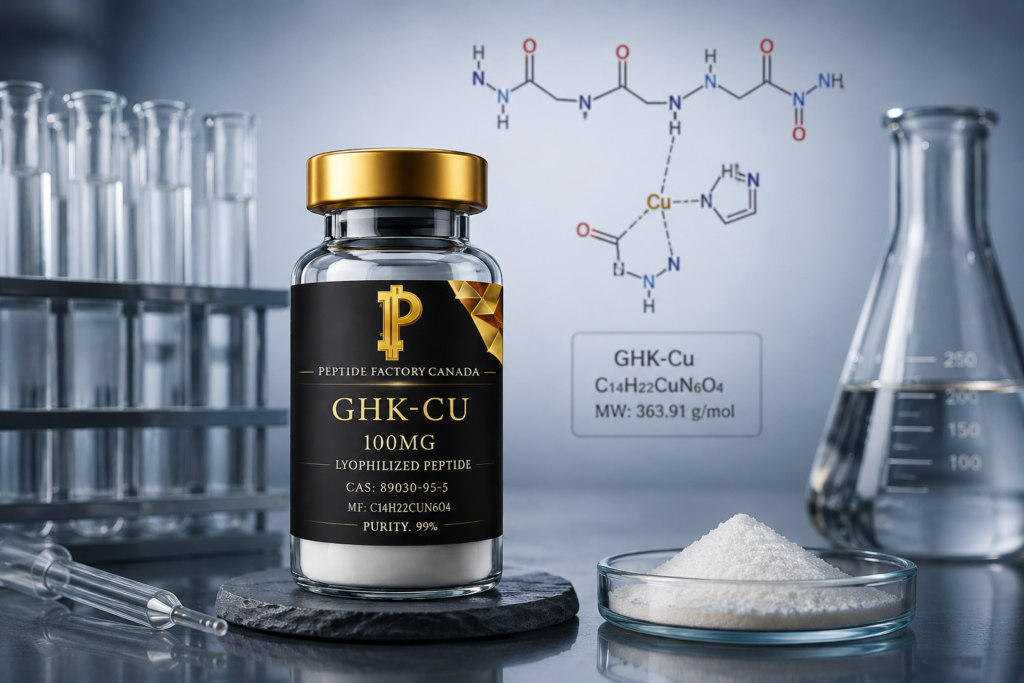
Chemical Identity and Copper Coordination
The sequence matters because each residue contributes different chemical features. Glycine provides the N-terminal region, histidine supplies an imidazole-containing side chain, and lysine contributes an additional basic side chain. Spectroscopic research has described copper coordination involving nitrogen and oxygen donor atoms, with solution species affected by pH and experimental conditions.
Researchers should distinguish free GHK from its copper complex. Adding copper changes mass, charge distribution, colour, spectroscopy and potentially assay behaviour. It may also create more than one solution species when pH, stoichiometry or competing ligands change. Therefore, a GHK assay alone does not prove the identity or copper loading of a GHK-Cu research compound.
Names used in catalogues can also hide differences. “Copper peptide,” “copper tripeptide-1,” “prezatide copper,” acetate-associated material and a simple Cu-GHK description may refer to different analytical presentations. A reproducible study records the complete chemical designation, peptide sequence, metal-to-ligand ratio, counterions, water content and lot number.
Discovery and Endogenous GHK Research
GHK was described as a human plasma constituent before much of the modern cosmetic discussion developed. A 1980 study examined the association of the tripeptide with copper and iron in plasma and tested peptide-metal complexes in cultured cells. Later structural research used nuclear magnetic resonance and electron paramagnetic resonance to investigate copper-binding species across a range of pH conditions.
Finding a peptide or peptide-related signal in plasma does not establish that every commercial GHK-Cu preparation reproduces an endogenous function. Concentration, localization, binding partners, degradation, cell type and copper availability can all change a biological response. Endogenous occurrence and therapeutic efficacy are separate questions.
GHK-Cu Research Compound: Evidence at a Glance
| Study | Model | Main research signal | Important limitation |
|---|---|---|---|
| 1980 plasma and cell study | Human plasma analysis and cultured cells | Examined GHK association with copper and iron and peptide-metal effects | Does not establish a clinical benefit |
| 1988 collagen study | Cultured fibroblasts | Reported increased collagen synthesis under defined conditions | In vitro endpoint, not a human treatment trial |
| 1993 wound-chamber study | Rat experimental wounds | Reported extracellular-matrix accumulation and collagen-related changes | Animal model with direct experimental exposure |
| 1996 wound and fibroblast study | Guinea-pig skin and cultured fibroblasts | Reported collagen-expression changes but slower skin reorganization in vivo | Shows that outcomes are not uniformly beneficial |
| 2000 MMP-2 study | Dermal fibroblast cultures | Reported changes in MMP-2 and tissue inhibitors of metalloproteinases | Cell-culture markers cannot prove clinical repair |
| 2011 penetration study | Excised human skin in vitro | Measured copper retention and permeation from a GHK-Cu preparation | Ex vivo delivery study, not clinical efficacy |
| 2016 preformulation study | Analytical and formulation testing | Characterized solubility, hydrophilicity, degradation and excipient compatibility | Formulation data do not demonstrate a health outcome |
| 2017 liposome study | Cells and mouse scald-wound model | Examined liposomal GHK-Cu, proliferation and wound-model endpoints | Modified formulation and animal model |
The evidence map is more useful than a list of benefits. It shows that different papers studied different materials, species, exposure systems and endpoints. A result in cultured fibroblasts cannot be treated as proof of wrinkle reduction, hair growth or wound healing in people.
Collagen and Extracellular-Matrix Research
One frequently cited 1988 experiment reported stimulation of collagen synthesis in fibroblast cultures at very low tested concentrations. A later rat wound-chamber study measured dry weight, DNA, protein, collagen, glycosaminoglycans and collagen-related messenger RNA. These papers support laboratory questions about matrix production, but their designs do not establish an authorized therapy.
Extracellular-matrix biology involves both production and remodelling. In 2000, researchers reported that GHK-Cu changed MMP-2 expression and increased secretion of TIMP-1 and TIMP-2 in fibroblast cultures. Matrix metalloproteinases and their inhibitors participate in turnover; a change in one marker is not simply “more collagen” or “better repair.”
Researchers should also include findings that complicate a promotional narrative. A guinea-pig study reported slower skin reorganization and delayed fibroblast activation in its in vivo model, while cultured cells showed decreased reproduction and increased collagen expression. That combination demonstrates why cell proliferation, collagen expression, tissue architecture and functional healing must be measured separately.
Wound Models and the Limits of Translation
Wound studies vary by species, injury type, formulation, timing and endpoint. Rat wound chambers, guinea-pig dorsal-skin models and mouse scald models do not reproduce the full physiology or safety requirements of human clinical care. A liposomal formulation is also not equivalent to unformulated GHK-Cu because encapsulation can change stability, tissue exposure and cellular uptake.
Useful research separates descriptive signals from claims. Collagen content, histology, angiogenesis markers, cell viability and closure rate answer different questions. A study should prespecify its primary endpoint, include vehicle and copper controls, report blinding where feasible and account for the base formulation.
Accordingly, GHK-Cu research compound material should not be described as proven to heal wounds, reverse aging or regenerate tissue in humans. Those phrases exceed the evidence and can create regulatory and safety problems.
Skin Penetration and Formulation Research
GHK-Cu is hydrophilic, which creates a formulation challenge because the outer skin barrier is comparatively lipophilic. A 2011 in vitro study used isolated human skin layers and flow-through diffusion cells to measure copper retention and permeation over 48 hours. The experiment provides delivery data under defined conditions, not proof that a finished cosmetic or research solution produces a clinical result.
Formulation variables include pH, ionic strength, copper-to-peptide ratio, buffer, preservative, surfactant, chelator, container and delivery system. Competing ligands may alter copper coordination. Liposomes or other carriers can change apparent penetration, but the carrier introduces its own controls and stability questions.
When comparing papers, confirm whether the test article was GHK, GHK-Cu, an acetate-associated preparation, a liposomal product or another copper-peptide complex. Researchers should not merge these into one evidence category merely because each source uses the phrase “copper peptide.”
Stability, Degradation and Compatibility
A 2016 preformulation study used stability-indicating reversed-phase HPLC and mass spectrometry to characterize GHK-Cu. It reported susceptibility to basic and oxidative stress, less degradation under acidic stress and material-dependent compatibility with tested formulation components. Those results illustrate why storage claims require a defined formulation and method.
Potential changes include peptide-bond hydrolysis, oxidation, copper redistribution, adsorption to surfaces and interactions with buffers or excipients. Visible colour may shift with concentration, pH or coordination chemistry, but an unchanged blue appearance cannot demonstrate intact sequence or purity.
For a stability study, laboratories should define time points, temperature, light exposure, container closure, headspace, humidity, freeze-thaw conditions and acceptance criteria. A stability-indicating method must separate the main analyte from relevant degradation products rather than reporting only a total absorbance value.
GHK-Cu Research Compound: Quality Testing
High-performance liquid chromatography can estimate chromatographic purity and detect certain impurities under a defined method. The column, mobile phase, gradient, wavelength, injection conditions and integration rules affect the result. Therefore, a statement such as “99% purity” is incomplete without a chromatogram, method and lot number.
Mass spectrometry supports peptide identity by comparing observed ions with the expected GHK-related mass. However, copper coordination, salts, adducts and ionization conditions can complicate spectra. Laboratories should specify whether the reported value applies to free GHK, Cu-GHK or another presentation.
Elemental or copper analysis can help evaluate copper content and metal-to-peptide consistency. Suitable techniques may include ICP-MS, ICP-OES or a validated alternative. Peptide purity and copper content answer different questions, so one should not substitute for the other.
- Confirm the Gly-His-Lys sequence and expected molecular presentation.
- Review HPLC or UPLC purity with the actual chromatogram.
- Review mass data and the interpretation used for the copper complex.
- Check copper content, water content and counterions where relevant.
- Match every report to the received batch number.
- Document the testing laboratory, method, date and specifications.
- Do not infer sterility, endotoxin status or bioburden from peptide purity.
How to Read a GHK-Cu Certificate of Analysis
A useful certificate of analysis is batch-specific and method-specific. It should identify the material, sequence, lot, test date, specification, result and analytical procedure. Ideally, supporting documentation includes the chromatogram and interpretable identity data rather than a logo and a single percentage.
Check whether the COA names GHK, GHK-Cu, copper tripeptide-1 or a particular salt. Then compare that name with the vial label and experimental protocol. Confirm whether purity is reported on an anhydrous basis, as-is basis or another convention. Water, acetate and residual solvents can affect mass balance.
A COA only supports tests that were actually performed. Chromatographic purity does not establish sterility, endotoxin, heavy-metal suitability, microbial limits or clinical safety. Researchers should define acceptance criteria from the intended analytical experiment, not from marketing language.
Experimental Design Checklist
- Define whether the test article is free GHK, GHK-Cu or a formulated derivative.
- Verify sequence, copper content, lot identity and storage history before the experiment.
- Include vehicle, untreated, free-peptide and copper controls when scientifically appropriate.
- Control pH, ionic strength, serum, competing chelators and container materials.
- Prespecify primary endpoints and separate molecular markers from functional outcomes.
- Use biological and technical replicates with a documented statistical plan.
- Record the exact formulation, exposure duration and analytical concentration.
- Report null or contradictory findings alongside positive results.
- Keep all work within an approved institutional protocol and research-only scope.
Storage and Laboratory Handling
Storage requirements depend on the exact sequence presentation, salt, water content, container and study duration. Follow the batch documentation, safety data sheet and a validated institutional procedure. Protect the material from uncontrolled moisture, contamination, light and temperature excursions when the documentation requires it.
Laboratories should log receipt, lot number, container condition, storage location and any excursion. Where a validated method supports aliquoting, it may reduce repeated handling. Analysts should establish solution stability in the actual buffer and container used by their protocol.
This guide intentionally excludes reconstitution recipes and dosing instructions. Research procedures belong in approved laboratory protocols. Questions about health or treatment belong with licensed healthcare professionals.
GHK-Cu Research Compound in Canada
Health Canada has specifically listed GHK-Cu among examples of unauthorized injectable peptide drugs seized in Canada. The agency warns that unauthorized products have not been assessed for safety, efficacy and quality and advises consumers not to buy or use them. An eight-digit Drug Identification Number is one indicator used for authorized drug products in Canada.
Health Canada also states that “For Research Use Only – Not for Human Consumption” wording does not make an unauthorized drug legal or exempt from regulatory requirements. In May 2026, the agency published a Type I recall involving GHK-Cu powder identified as an unauthorized active pharmaceutical ingredient. These notices make accurate positioning especially important.
Consequently, consumers should not inject, ingest or otherwise self-administer GHK-Cu research material. Products discussed here are restricted to qualified laboratory research and are not approved treatments. Laboratories should assess the rules that apply to their institution, import route, material and intended study. This article provides general information, not legal advice.
GHK-Cu Research Compound FAQ
What does GHK-Cu stand for?
GHK represents the amino-acid sequence glycine-histidine-lysine. Cu denotes copper. GHK-Cu therefore describes a copper complex of the GHK tripeptide.
What is the GHK amino-acid sequence?
The sequence is Gly-His-Lys, formally glycyl-L-histidyl-L-lysine. Because it contains three residues, GHK is a tripeptide.
Is GHK the same as GHK-Cu?
No. GHK is the free peptide, while GHK-Cu is its copper-associated complex. Copper changes molecular mass, coordination chemistry, spectroscopy and potentially experimental behaviour.
What is copper tripeptide-1?
Copper tripeptide-1 is a name commonly associated with the GHK-copper complex in cosmetic and ingredient contexts. Researchers should still verify the exact chemical presentation and batch documentation.
Is GHK naturally found in the human body?
GHK has been described as a human plasma constituent, and early research examined its association with copper and iron. Endogenous occurrence does not prove that a commercial research material is safe or therapeutically effective.
Why is GHK-Cu blue?
Copper coordination can produce a blue colour. However, colour is only a visual characteristic; it cannot confirm sequence, copper ratio, purity or freedom from degradation.
What is the molecular weight of GHK-Cu?
PubChem lists 403.92 g/mol for one Cu-GHK representation. The applicable mass can differ with salts, hydrates, adducts or analytical conventions, so laboratories should use batch-specific identity data.
What do researchers study GHK-Cu for?
Research areas include copper coordination, fibroblast responses, collagen expression, extracellular-matrix turnover, experimental wound models, skin penetration, delivery systems and formulation stability.
Does GHK-Cu increase collagen?
Some fibroblast and animal experiments reported collagen-related changes under defined conditions. Those findings are model-specific and do not establish a human anti-aging or wound-healing treatment.
Does GHK-Cu heal wounds?
It has been studied in cell and animal wound models, with varied endpoints and formulations. The evidence does not justify using a research reagent for human wound care.
Is GHK-Cu proven to reverse skin aging?
No. Laboratory and formulation findings are often summarized with anti-aging language, but they do not amount to large, independent clinical evidence for an injectable or research-only product.
Does GHK-Cu grow hair?
Broad hair-growth claims should be treated cautiously. Studies of other copper peptides, cell models or cosmetic ingredients cannot automatically establish efficacy for a particular GHK-Cu research compound.
Can GHK-Cu cross the skin barrier?
An in vitro human-skin study measured copper retention and permeation from a defined GHK-Cu preparation. Skin delivery depends on formulation, concentration, exposure system and barrier condition; penetration does not prove clinical efficacy.
Are liposomal GHK-Cu and unformulated GHK-Cu equivalent?
No. Liposomal encapsulation can change stability, distribution and cellular exposure. Results from a liposomal formulation should not be assigned automatically to unformulated material.
How is GHK-Cu purity measured?
HPLC or UPLC can estimate chromatographic purity under a defined method. The result should be supported by a chromatogram, method details, test date and matching batch number.
Does HPLC prove GHK-Cu identity?
No. Chromatography and identity testing answer different questions. Mass spectrometry, spectroscopy or another validated method should support identity, while copper analysis may support metal content.
Why should a GHK-Cu COA report copper content?
Because peptide purity alone does not establish copper loading or metal-to-peptide consistency. Copper content provides an additional attribute for qualifying the complex.
Does high GHK-Cu purity mean the vial is sterile?
No. Purity, identity, sterility, endotoxin and bioburden are separate attributes. A certificate supports only the tests and methods it actually reports.
Can colour confirm GHK-Cu quality?
No. Colour may reflect copper coordination and concentration, but it cannot exclude sequence errors, impurities, incorrect copper ratio or degradation.
What can degrade GHK-Cu?
Potential stressors include unsuitable pH, oxidation, heat, light, moisture, repeated handling and incompatible excipients. The relevant risks depend on formulation and must be tested with a stability-indicating method.
How should laboratories store GHK-Cu?
Follow the batch documentation, safety data sheet and a validated institutional procedure. Record temperature, light exposure, container condition, preparation history and any excursion.
Is GHK-Cu approved by Health Canada?
GHK-Cu research material is not presented here as an authorized therapeutic product. Health Canada has specifically warned about unauthorized injectable GHK-Cu products and published a recall involving unauthorized GHK-Cu active pharmaceutical ingredient powder.
Can GHK-Cu research material be injected or ingested?
No. Research material is not for injection, ingestion, topical self-use or veterinary administration. Unauthorized use can create serious health and regulatory risks.
Does this guide provide GHK-Cu dosing or reconstitution instructions?
No. Dosing and self-administration instructions are inappropriate for research-only material. This guide covers scientific evidence, analytical quality, sourcing principles, handling and Canadian safety context.
Where can researchers find GHK-Cu studies?
Search PubMed for peer-reviewed papers and ClinicalTrials.gov for registered studies. Confirm the exact peptide form, copper presentation, model, controls, formulation, sample size and endpoints before comparing results.
GHK-Cu Research Compound: Research Summary
GHK-Cu is a copper-associated Gly-His-Lys tripeptide with a research history spanning plasma chemistry, copper coordination, fibroblast biology, extracellular-matrix turnover, wound models, skin penetration and formulation science. Several studies reported laboratory signals, while other findings showed slower tissue reorganization or emphasized delivery and stability limitations.
For credible GHK-Cu research, laboratories should verify the exact material, review HPLC and mass data, assess copper content, match the COA to the batch, control pH and competing ligands, and report model limitations. Above all, GHK-Cu research compound material must remain outside human or veterinary use.
Related Laboratory Resources
- Review GHK-Cu 200 mg laboratory specifications
- Browse research peptides and laboratory compounds
- Learn about Peptide Factory Canada quality standards
- Request technical or batch documentation
Research use only: The materials discussed here are not for human or veterinary use, diagnosis, treatment or prevention. Qualified purchasers should confirm documentation, protocol suitability and compliance requirements before procurement.
References
- PubChem Cu-GHK compound record
- GHK association with copper and iron in plasma, 1980
- NMR and EPR study of GHK-copper interaction, 1983
- GHK-Cu and collagen synthesis in fibroblast cultures, 1988
- GHK-Cu in a rat wound-chamber model, 1993
- Tripeptide-copper complexes in guinea-pig wounds and fibroblasts, 1996
- GHK-Cu and MMP-2 expression in fibroblasts, 2000
- Human skin penetration of a copper tripeptide in vitro, 2011
- GHK-Cu physicochemical and preformulation study, 2016
- Liposomal GHK-Cu cell and mouse wound-model study, 2017
- Health Canada warning on unauthorized injectable peptides, including GHK-Cu
- Health Canada GHK-Cu powder recall
- ClinicalTrials.gov GHK-Cu search
