
MOTS-c laboratory studies examine a mitochondrial-derived peptide involved in cellular energy regulation, mitochondrial-to-nuclear communication, and metabolic stress responses. Researchers most often evaluate MOTS-c alongside AMPK signalling, skeletal-muscle metabolism, glucose-utilization models, and age-associated changes in cellular bioenergetics.
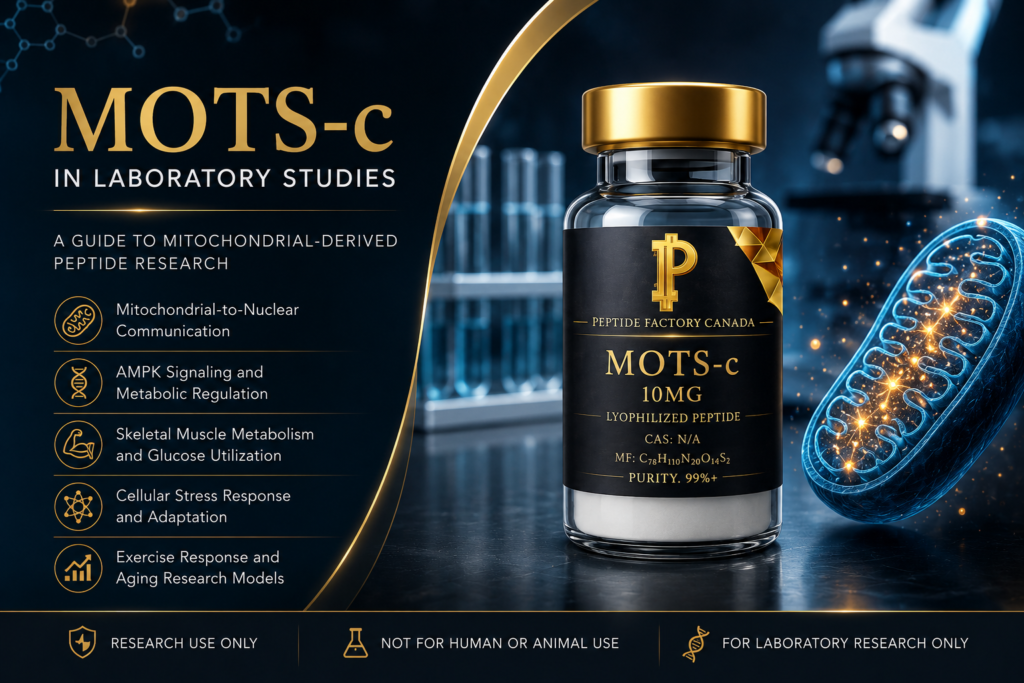
Cellular Metabolism in MOTS-c Laboratory Studies
In controlled laboratory environments, researchers use MOTS-c to study how mitochondria communicate with the nucleus during periods of cellular stress. Published research describes MOTS-c as a mitochondrial-encoded peptide that may promote metabolic homeostasis partly through AMPK-related pathways and adaptive nuclear gene-expression responses.
5 Key Areas in MOTS-c Laboratory Studies
- AMPK Pathway Activity: Studying how MOTS-c interacts with cellular energy-sensing pathways involved in metabolic adaptation.
- Glucose Metabolism Models: Observing its reported role in skeletal muscle glucose utilization and insulin-signalling models.
- Mitochondrial-to-Nuclear Communication: Examining research showing that MOTS-c can regulate adaptive nuclear gene expression after nuclear translocation under metabolic stress.
- Exercise-Response Research: Studying MOTS-c expression in relation to exercise-induced mitochondrial signalling and skeletal muscle metabolism.
- Cellular Stress Resistance: Investigating how MOTS-c may influence cellular adaptation during nutrient limitation, oxidative stress, and metabolic imbalance.
Handling Protocols for MOTS-c Laboratory Studies
Because MOTS-c is a peptide, laboratories should protect samples from contamination, excessive heat, repeated freeze-thaw cycles, and prolonged light exposure. In addition, researchers should follow validated sterile preparation, reconstitution, and storage protocols that support peptide stability.
Laboratories should retain batch-specific documentation, including purity testing and a certificate of analysis, whenever available. Moreover, qualified personnel must confine experimental work to laboratory settings and avoid extrapolating results to clinical, cosmetic, veterinary, athletic, or consumer applications.
Research-Use Boundaries
MOTS-c remains an investigational research compound. Although current literature supports continued study of mitochondrial signalling, metabolic regulation, skeletal-muscle biology, and cellular stress pathways, the evidence does not establish clinical outcomes, safety, or efficacy.
These materials are not approved by Health Canada for cosmetic application, therapeutic treatment, injection, ingestion, or any form of human or animal use. Product descriptions and technical information are provided for research reference only.
MOTS-c Laboratory Studies FAQ
What is MOTS-c studied for in laboratories?
For example, researchers study MOTS-c in mitochondrial signalling, AMPK pathway activity, cellular stress responses, skeletal-muscle metabolism, and glucose-utilization models.
Is MOTS-c approved for human use?
No. MOTS-c remains a research compound in this guide. The article does not provide human or animal consumption, therapeutic, injection, ingestion, cosmetic, or veterinary guidance.
Why is MOTS-c considered a mitochondrial-derived peptide?
Scientific literature identifies MOTS-c as a peptide encoded by the mitochondrial genome. Therefore, researchers classify it among mitochondrial-derived peptides.
What documentation supports MOTS-c laboratory studies?
In addition, researchers should review batch-specific certificates of analysis, purity results, identity testing, storage recommendations, and experimental records. Documentation strengthens traceability and reproducibility but does not establish clinical suitability.
References
The following scientific and regulatory sources support the mitochondrial signalling, AMPK, metabolic-stress, and research-use information in this guide.
- Nature Communications – MOTS-c and mitochondrial-encoded regulation.
- PMC Review – MOTS-c and mitochondrial-derived peptide research.
- USADA – What is MOTS-c peptide?.
