
Selank laboratory studies examine a synthetic heptapeptide across tuftsin analog, neuropeptide, neuroimmune, and neurotransmission research. Selank contains the Thr-Lys-Pro-Arg sequence associated with tuftsin plus a Pro-Gly-Pro motif discussed in relation to peptide stability in experimental models. Chemical references identify it as Thr-Lys-Pro-Arg-Pro-Gly-Pro, with molecular formula C33H57N11O9 and CAS number 129954-34-3. [1][2]
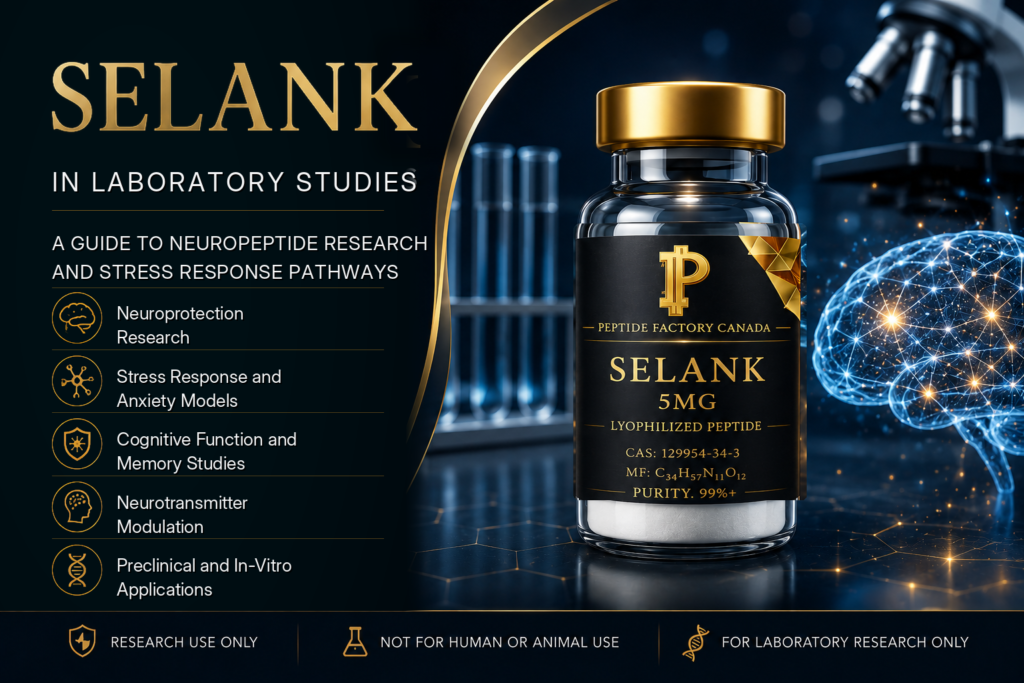
In particular, researchers study Selank in GABAergic signalling, stress-response models, BDNF-related pathways, and neuroimmune gene-expression research. These Selank laboratory studies use animal, cell, and biochemical models; they do not establish clinical safety or efficacy. This article provides scientific reference material only and does not offer dosing, preparation, clinical, veterinary, cosmetic, or consumer-use guidance.
What Are Selank Laboratory Studies?
Selank is a short synthetic regulatory peptide composed of seven amino acids. Scientific literature describes it as an analog of the endogenous tuftsin molecule, a fragment of the heavy chain of human immunoglobulin G. In addition, researchers designed the Pro-Gly-Pro extension at the C-terminus to improve stability and duration in experimental models. [2]
Because of this design, Selank connects several research categories: tuftsin analogs, glyproline-containing regulatory peptides, neuropeptides, and neuroimmune signalling compounds. Together, these categories explain why researchers examine its structure, pathway interactions, and model-dependent effects rather than treating it as a consumer compound.
GABAergic Signalling Research
GABAergic signalling represents a central area of Selank research. For example, one Frontiers in Pharmacology study measured 84 neurotransmission-related genes in rat frontal cortex after Selank or GABA administration. The researchers reported significant expression changes in 45 genes at one hour and 22 genes at three hours. Therefore, they proposed that complex nerve-cell responses may involve GABAergic-system modulation. [2]
However, a separate Frontiers in Pharmacology study examined GABA, Selank, and olanzapine in IMR-32 neuroblastoma cells. Selank did not directly change mRNA levels of the GABAergic-system genes measured in that cell model. Combined responses with GABA and olanzapine instead pointed to more complex, model-dependent interactions. Therefore, these results support further mechanistic research rather than conclusions about human effects. [3]
6 Key Areas in Selank Laboratory Studies
- Tuftsin analog research: Selank is studied as a synthetic analog of tuftsin, a short immunologically relevant peptide fragment. Its Thr-Lys-Pro-Arg-Pro-Gly-Pro sequence makes it relevant to glyproline-containing peptide research. [1][2]
- GABAergic pathway models: Researchers have examined how Selank may influence GABAergic neurotransmission, receptor-related gene expression, and inhibitory signalling pathways in controlled animal and cell models. [3][4]
- BDNF and neurotrophic signalling: Published studies have examined Selank in relation to BDNF expression and BDNF content in rat hippocampal and prefrontal cortex models. [5][6]
- Stress-response and behavioural models: Preclinical literature has discussed Selank in relation to stress-response and anxiety-like behavioural models. Public content should frame this as behavioural model research, not human-use advice. [3]
- Neuroimmune gene-expression research: Selank has been investigated in relation to inflammation-related genes, cytokine models, and immune-neural communication. [7]
- Peptide stability and glyproline motifs: The Pro-Gly-Pro segment is relevant to laboratory discussions of peptide stability and enzymatic degradation. This can be included as structural background without making product-performance claims. [2]
Selank and BDNF Expression Models
Brain-derived neurotrophic factor (BDNF) is a common marker in studies of neuronal plasticity, memory models, and stress-related neural adaptation. Accordingly, researchers have examined Selank alongside BDNF expression and BDNF content in preclinical models. For example, a 2008 Doklady Biological Sciences study evaluated how intranasal Selank administration affected BDNF expression in the rat hippocampus in vivo. [4]
A later rat study evaluated Selank in a model of ethanol-induced memory impairment and reported changes involving BDNF content in the hippocampus and frontal cortex. Because the experiment used a preclinical model, its results belong to cognitive-function research and do not establish consumer cognitive-enhancement effects. [5]
Neuroimmune Gene-Expression Research
Selank’s tuftsin-related structure also makes it relevant to neuroimmune research. Researchers have examined inflammation-related gene expression, cytokine models, and communication between immune and neural pathways. As a result, this work helps define a neuroimmune research cluster without supporting broad claims such as “immune boosting.” [6]
This research angle also helps distinguish Selank from other neuropeptides. The article can discuss gene-expression models, cytokine-related pathways, neurotransmission markers, and neuroimmune signalling without making clinical claims or implying that Selank treats anxiety, improves cognition, or produces a therapeutic effect.
Research Handling Protocols
Because Selank is a peptide, laboratories should protect it from moisture, excessive heat, direct light, and repeated freeze-thaw cycles. In addition, researchers should follow validated laboratory protocols, institutional procedures, and batch-specific documentation instead of generalized online preparation instructions.
Laboratories should retain available analytical documentation, including certificates of analysis, batch identity, purity testing, and mass-confirmation data. Moreover, qualified research personnel should limit experimental work to appropriate laboratory settings. Researchers must not extrapolate these findings to clinical, cosmetic, veterinary, athletic, or consumer applications.
Quality Control for Selank Laboratory Studies
For reproducible research, laboratories should support each Selank batch with strong analytical documentation. Key records include a certificate of analysis, HPLC purity report, mass-spectrometry confirmation, batch number, analysis date, and storage recommendations. Furthermore, cell-culture or sensitive biochemical assays may require sterility, endotoxin, or solvent-compatibility records.
Researchers should verify batch-specific analytical data before using Selank in controlled laboratory studies. Clear documentation helps teams confirm identity, compare results across experiments, and maintain traceability from receipt through analysis.
Research-Use Boundaries
Selank remains an investigational research compound in this article. Although current literature supports continued laboratory study of GABAergic signalling, neurotrophic pathways, stress responses, and neuroimmune gene expression, the evidence does not establish clinical outcomes, safety, or efficacy.
These materials are not approved by Health Canada for cosmetic application, therapeutic treatment, injection, ingestion, nasal administration, or any form of human or animal use. Product descriptions and technical information are provided for research reference only. Selank should be handled only by qualified research professionals in appropriate laboratory settings.
Key Takeaways from Selank Laboratory Studies
Selank is a compact tuftsin-derived heptapeptide that continues to attract attention in peptide science because of its connection to neurotransmission, BDNF-related research, and neuroimmune signalling. Its small structure, regulatory peptide background, and model-dependent interactions with GABAergic and neurotrophic pathways make it a relevant subject for laboratory study.
Overall, the strongest interpretation remains cautious and research-focused. The evidence explains what Selank is, why it appears in scientific literature, and which laboratory pathways researchers continue to study, while clear research-use-only boundaries prevent clinical or consumer conclusions.
Selank Laboratory Studies FAQ
In addition, the following questions summarize the article’s main scientific, evidence, handling, and quality-control points for readers evaluating Selank research literature.
What is Selank studied for in laboratories?
For example, laboratories study Selank in tuftsin analog research, GABAergic signalling, neurotransmission-related gene expression, BDNF models, behavioural stress responses, and neuroimmune pathways.
Is Selank a tuftsin analog?
Yes. Specifically, published literature describes Selank as a synthetic analog of tuftsin with the amino acid sequence Thr-Lys-Pro-Arg-Pro-Gly-Pro. [1][2]
Why do researchers discuss Selank and GABAergic signalling?
Researchers have investigated Selank alongside neurotransmission-related genes and possible GABAergic-system modulation. However, the findings depend on the model and support laboratory research only. [2][3]
Is Selank approved for human use in Canada?
No. Health Canada has warned about unauthorized injectable peptide drugs. Therefore, researchers should keep Selank content and experiments strictly within laboratory-use boundaries. [7]
What documentation supports Selank laboratory studies?
Researchers should review batch-specific certificates of analysis, HPLC purity data, mass-spectrometry confirmation, batch numbers, storage recommendations, and any sterility or endotoxin records relevant to the experiment. Therefore, documentation strengthens traceability and reproducibility but does not establish clinical suitability.
What is the amino-acid sequence of Selank?
Selank has the seven-amino-acid sequence Thr-Lys-Pro-Arg-Pro-Gly-Pro. Therefore, researchers classify it as a synthetic heptapeptide and tuftsin analog.
How many amino acids are in Selank?
Specifically, Selank contains seven amino acids. Accordingly, scientific descriptions call it a heptapeptide.
Is Selank a peptide or a small molecule?
Accordingly, Selank is a synthetic peptide, not a conventional small-molecule compound. In particular, its identity comes from its defined seven-amino-acid sequence.
How does Selank differ from tuftsin?
Tuftsin contains the Thr-Lys-Pro-Arg sequence, whereas Selank adds a Pro-Gly-Pro motif. As a result, researchers examine Selank as a tuftsin-derived regulatory peptide with different experimental stability characteristics.
Which experimental models appear in Selank research?
For example, Selank laboratory studies include animal, cell-culture, biochemical, gene-expression, and behavioural models. However, results from these systems cannot establish clinical safety or efficacy.
Why can Selank findings differ between laboratory models?
Different models measure different genes, tissues, time points, and experimental conditions. Therefore, a result in rat cortex may not match a result from an isolated cell line.
What do Selank and BDNF studies measure?
Selank and BDNF studies measure markers related to neurotrophic signalling, neuronal plasticity, and stress-associated adaptation. For example, cited rat studies assessed BDNF expression or content in the hippocampus and frontal cortex.
What do neuroimmune Selank studies examine?
Neuroimmune studies examine inflammation-related genes, cytokine pathways, and communication between neural and immune systems. However, these endpoints do not prove a general immune-boosting effect.
Do Selank laboratory studies prove anxiety or cognitive benefits?
No. However, laboratory and preclinical findings do not establish that Selank treats anxiety, improves cognition, or produces therapeutic benefits in people. Therefore, responsible summaries should describe measured pathways and model-specific observations only.
Can laboratory findings be used as Selank dosing guidance?
No. Laboratory findings do not provide consumer dosing, injection, nasal-administration, or preparation instructions. Instead, qualified researchers should follow approved institutional protocols and study-specific documentation.
What does an HPLC purity report show for Selank?
In addition, an HPLC report estimates sample purity and documents chromatographic peaks under stated test conditions. Laboratories should pair purity data with identity testing and batch-specific records.
Why is mass-spectrometry confirmation important?
Mass spectrometry helps laboratories compare a sample’s measured mass with the expected Selank molecule. Consequently, this record supports identity verification but does not establish sterility or clinical suitability.
What is a Selank certificate of analysis?
A certificate of analysis summarizes batch-specific test results, identifiers, dates, and specifications. Therefore, researchers should verify that the certificate matches the exact batch received.
How should laboratories store Selank research material?
Therefore, laboratories should follow batch-specific storage recommendations, validated stability data, and institutional procedures. Moreover, teams should document temperature, light exposure, moisture control, and freeze-thaw history when relevant.
Why are sterility and endotoxin records relevant?
Sterility and endotoxin records may matter for sensitive cell-based or biochemical experiments. However, these records support laboratory quality control and do not make a research product suitable for human or animal use.
Where can researchers find Selank source literature?
Researchers can review the peer-reviewed and regulatory sources for Selank laboratory studies in this article’s References section. In addition, they should confirm study design, model, endpoints, and publication details before interpreting a result.
References
[1] ChemicalBook: Selank peptide, CAS 129954-34-3. https://www.chemicalbook.com/ChemicalProductProperty_EN_CB33161651.htm
[2] Volkova A, et al. Selank Administration Affects the Expression of Some Genes Involved in GABAergic Neurotransmission. Frontiers in Pharmacology. 2016. https://www.frontiersin.org/journals/pharmacology/articles/10.3389/fphar.2016.00031/full
[3] Filatova E, et al. GABA, Selank, and Olanzapine Affect the Expression of Genes Involved in GABAergic Neurotransmission in IMR-32 Cells. Frontiers in Pharmacology. 2017. https://www.frontiersin.org/journals/pharmacology/articles/10.3389/fphar.2017.00089/full
[4] Inozemtseva LS, et al. Intranasal administration of the peptide Selank regulates BDNF expression in the rat hippocampus in vivo. Doklady Biological Sciences. 2008. https://link.springer.com/article/10.1134/S0012496608040066
[5] Kolik LG, et al. Selank, Peptide Analogue of Tuftsin, Protects Against Ethanol-Induced Memory Impairment by Regulating BDNF Content in the Hippocampus and Prefrontal Cortex in Rats. PubMed. 2019. https://pubmed.ncbi.nlm.nih.gov/31625062/
[6] Kolomin T, et al. The temporary dynamics of inflammation-related genes expression under tuftsin analog Selank action. PubMed. 2014. https://pubmed.ncbi.nlm.nih.gov/24291245/
[7] Health Canada: Unauthorized injectable peptide drugs seized and sold by Canada Peptide may pose serious health risks. 2025. https://recalls-rappels.canada.ca/en/alert-recall/unauthorized-injectable-peptide-drugs-seized-and-sold-canada-peptide-may-pose-serious
Looking to source Selank for laboratory research? Peptide Factory Canada offers lab-tested Selank with third-party COA documentation. View the Selank 10mg product page for current specifications and availability.
