
SLU-PP-332 laboratory studies examine a synthetic small-molecule pan-agonist of estrogen-related receptors (ERR-alpha, ERR-beta, and ERR-gamma). Researchers use the compound in controlled preclinical models of mitochondrial function, cellular respiration, skeletal-muscle oxidative metabolism, fatty-acid oxidation, and ERR-
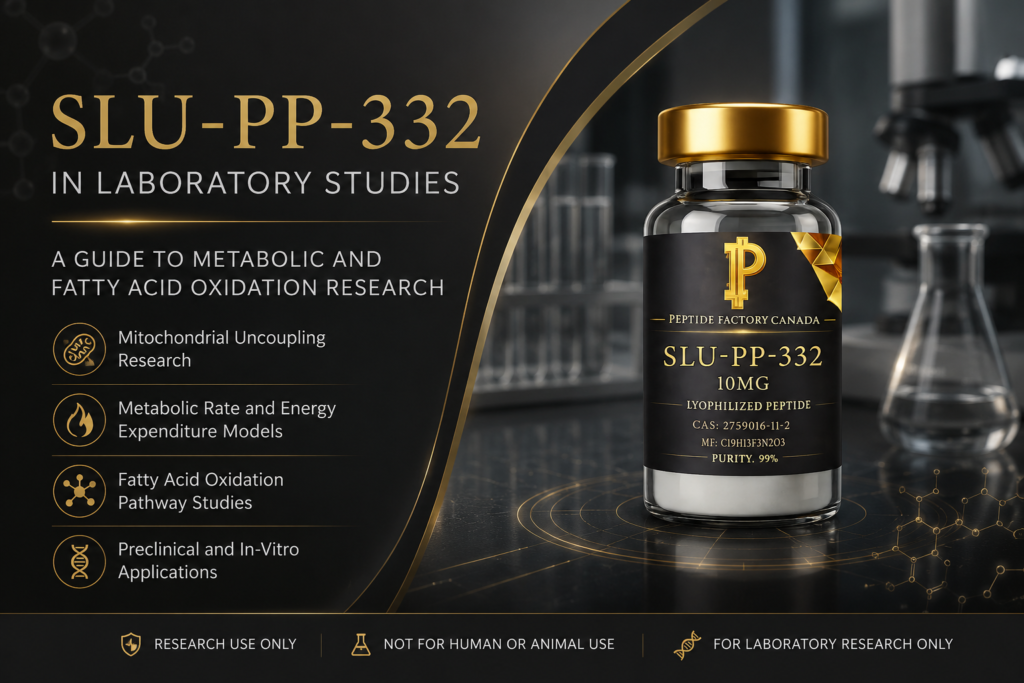
Although some online catalogs group SLU-PP-332 with peptides, scientific literature describes it as a small molecule rather than a peptide. Therefore, this guide focuses on ERR agonist research and laboratory methods, not human-use or treatment claims.
ERR Signalling in SLU-PP-332 Laboratory Studies
Researchers use SLU-PP-332 to examine how ERR activation affects energy-demanding tissues and cellular pathways. Published preclinical work reports activity across all three ERR receptor subtypes, with the strongest potency toward ERR-alpha. In addition, cell and animal models have explored mitochondrial function, cellular respiration, skeletal-muscle oxidative characteristics, and exercise-responsive gene-expression programs.
These studies connect SLU-PP-332 with models of mitochondrial respiration, oxidative metabolism, metabolic stress, and transcriptional regulation. However, researchers should confine the compound to qualified laboratory settings and avoid extrapolating preclinical observations to consumer, clinical, cosmetic, athletic, or therapeutic use.
7 Areas in SLU-PP-332 Laboratory Studies
- ERR Receptor Activity: Researchers evaluate pan-ERR agonism across ERR-alpha, ERR-beta, and ERR-gamma, including ERR-alpha-dependent transcriptional effects.
- Mitochondrial Respiration Models: For example, cell studies measure changes in mitochondrial function, cellular respiration, and oxidative metabolism.
- Skeletal-Muscle Oxidative Phenotype: In addition, preclinical models examine gene-expression patterns and muscle-fibre characteristics linked with aerobic metabolism.
- Fatty-Acid Oxidation Models: Animal studies examine how ERR activation affects fatty-acid utilization, energy expenditure, and metabolic adaptation.
- Metabolic-Stress Models: Researchers investigate ERR pathway activation in diet-induced and genetic obesity models without making human-treatment claims.
- Cardiac Metabolism Research: Moreover, preclinical models explore ERR agonism, mitochondrial function, fatty-acid metabolism, and cardiac stress-response pathways.
- Analytical Detection Methods: Laboratories use in vitro metabolism studies and LC-HRMS workflows to characterize SLU-PP-332 and related metabolites.
Handling Protocols for SLU-PP-332 Studies
Because SLU-PP-332 is a synthetic small molecule, laboratories should follow institutional procedures for research chemicals rather than peptide-handling assumptions. Before experiments, teams should review validated protocols, batch-specific analytical data, certificates of analysis, and available safety documentation.
Researchers should record the lot number, purity, solvent system, concentration, storage conditions, preparation date, and analytical method for each study. Moreover, laboratories should manage prepared solutions according to validated stability data and internal standard operating procedures. Appropriate protective equipment, contamination controls, and research-chemical disposal practices remain essential.
Research-Use Boundaries
SLU-PP-332 remains an investigational research compound. Current literature supports further preclinical study of ERR signalling, mitochondrial metabolism, skeletal-muscle biology, fatty-acid oxidation, metabolic-stress models, and analytical detection. However, these studies do not establish clinical outcomes, safety, or efficacy.
Health Canada has not approved these materials for cosmetic application, therapeutic treatment, injection, ingestion, athletic performance enhancement, weight loss, or any human or animal use. This article provides product descriptions and technical information for research reference only.
SLU-PP-332 Laboratory Studies FAQ
Is SLU-PP-332 a peptide?
No. Although some online catalogs group SLU-PP-332 with peptides, scientific literature describes it as a synthetic small-molecule ERR agonist, not a peptide.
What is SLU-PP-332 studied for in laboratories?
Researchers study SLU-PP-332 in models of ERR-alpha, ERR-beta, and ERR-gamma signalling, mitochondrial metabolism, cellular respiration, skeletal-muscle oxidative pathways, fatty-acid oxidation, and metabolic stress.
Is SLU-PP-332 approved for human use?
No. SLU-PP-332 remains a research compound in this guide. The article does not provide human-consumption, therapeutic, injection, ingestion, cosmetic, athletic-performance, weight-loss, or animal-use guidance.
Why should researchers avoid dosage and injection guidance?
Dosage and injection guidance would imply administration or consumer use. Therefore, this research guide limits discussion to laboratory studies, ERR agonist research, mitochondrial metabolism models, and handling documentation.
What documentation supports SLU-PP-332 laboratory studies?
Researchers should review batch-specific certificates of analysis, purity and identity testing, storage recommendations, analytical methods, and experimental records. This documentation supports traceability and reproducibility but does not establish clinical suitability.
References
Primary study of SLU-PP-332 and exercise-response research
Open-access study of SLU-PP-332 in metabolic-syndrome models
Open-access study of pan-ERR agonists in cardiac-metabolism models
