
How to get peptides in Canada depends on whether you need an authorized medication or a laboratory research material. Therefore, a patient should use a licensed Canadian healthcare professional and pharmacy. A qualified researcher should follow institutional procurement rules, verify the supplier, review batch-specific analytical data and use research compounds only in legitimate non-human laboratory work.
This Canadian peptide sourcing guide explains the two pathways, the role of Health Canada, how to evaluate a peptide supplier in Canada, what a certificate of analysis should contain, which quality tests matter, and how shipping and storage affect research integrity. It is educational information—not medical advice, legal advice, a purchasing recommendation or instructions for human use.
Important: A “Research Use Only” or “Not for Human Consumption” label does not make a product safe to inject, ingest or apply to a person. Research materials are not substitutes for authorized medicines.
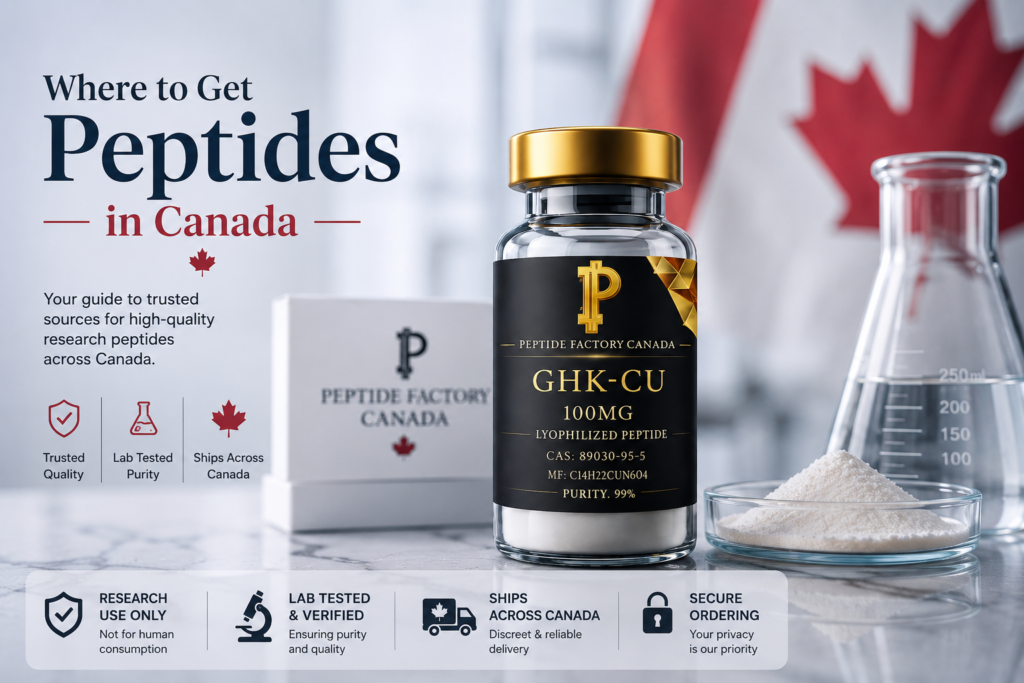
How to Get Peptides in Canada: Quick Answer
First, there are two fundamentally different routes. For an authorized peptide medication, speak with a licensed healthcare professional and obtain the prescribed product through a provincially licensed pharmacy. Verify authorization through Health Canada’s Drug Product Database, which lists drugs authorized for sale in Canada.
For non-human laboratory work, an institution or qualified researcher may procure a clearly identified research peptide through an approved scientific-supply process. The organization should document intended use, supplier identity, batch number, specifications, certificate of analysis, analytical methods, chain of custody and storage requirements. Regulations and institutional rules vary, so the purchaser remains responsible for confirming that a specific compound, transaction and intended use are permitted.
What Are Peptides?
In practical terms, peptides are molecules composed of amino acids joined by peptide bonds. They range from short sequences used as analytical standards to larger, more complex molecules studied in biochemical and pharmaceutical research. A peptide name alone does not describe its legal status, purity, salt form, counterion, hydration state, biological activity or suitability for a particular method.
In Canada, the intended use and the claims made about a product matter. Some peptide-based products are authorized drugs with a Drug Identification Number, while many compounds discussed online are experimental or unauthorized for human use. Researchers should keep pharmaceutical procurement and research-material procurement completely separate.
Are Peptides Legal in Canada?
However, there is no reliable one-word answer for every peptide. Status can depend on the molecule, formulation, concentration, intended use, claims, route, seller, buyer and applicable federal or provincial requirements. Health Canada explains that products offered to treat or prevent disease are regulated as drugs and must meet Canadian authorization requirements.
For example, Health Canada’s April 9, 2026 advisory on unauthorized injectable peptides sold online names examples including BPC-157, GHK-Cu, DSIP, MOTS-C, retatrutide and TB-500. The advisory says unauthorized drug products have not been assessed by Health Canada for safety, efficacy and quality, and directs consumers not to use products labelled “For Research Use Only – Not for Human Consumption.”
Importantly, that warning is directed at consumer use of unauthorized drugs. It should not be misread as a blanket legal opinion about every legitimate analytical standard or institutional research purchase. Laboratories should obtain compound-specific advice from their compliance office, research institution, biosafety program or qualified Canadian counsel when classification is uncertain.
The Two Canadian Peptide Pathways
| Need | Appropriate route | Key verification | Not appropriate |
|---|---|---|---|
| Medical diagnosis or treatment | Licensed healthcare professional and licensed pharmacy | Prescription when required, 8-digit DIN, product monograph and pharmacy licence | Research supplier, social-media seller or “wellness” vendor |
| Non-human laboratory research | Approved institutional or scientific procurement process | Supplier identity, batch-specific COA, specifications, analytical data and RUO documentation | Self-administration, clinical treatment, cosmetic use or veterinary treatment |
1. Authorized Peptide Medications
Canadians seeking a medicine should begin with a qualified health professional, not a peptide marketplace. Health Canada advises consumers to use prescription drugs under professional care and buy them only from licensed pharmacies. Its guide to choosing a safe online pharmacy explains how to check a Canadian address, prescription requirement, pharmacist access and provincial or territorial licensing.
2. Research Peptides for Laboratory Work
A research-use peptide is a scientific material, not a consumer health product. Suitable applications may include analytical method development, reference-standard comparison, receptor assays, cell-free systems or other approved laboratory studies. Procurement should be connected to a documented protocol, qualified personnel, suitable facilities and a waste-disposal plan.
Researchers can review the research compound catalogue, learn about the company’s quality-focused approach and contact the team through the Canadian research support page. Product listings and commercial availability do not replace a purchaser’s regulatory, institutional or analytical review.
How to Evaluate a Peptide Supplier in Canada
However, a professional-looking website is not evidence of material identity or quality. Evaluate a Canadian peptide supplier using records that can be checked independently. The most useful supplier review asks whether the documentation connects the advertised compound to the exact vial or package received.
| Criterion | Evidence to request | Common red flag |
|---|---|---|
| Business identity | Canadian business name, physical contact details and responsive support | No verifiable address or only direct messages |
| Intended use | Clear Research Use Only and non-human-use language | Dosing, injection or therapeutic promises |
| Batch traceability | Lot number on the package matching the COA | One generic COA reused for every batch |
| Identity | Mass spectrometry or another suitable identity method | Purity percentage presented as proof of identity |
| Purity | Chromatogram, method summary and result tied to the lot | A percentage with no method or raw-data context |
| Specifications | Declared sequence, form, quantity basis and acceptance criteria | Missing salt, counterion or assay basis |
| Shipping | Packaging and temperature plan appropriate to the material | No explanation for heat-sensitive shipments |
| Claims | Measured, research-focused descriptions | Guaranteed health, bodybuilding or anti-aging outcomes |
Certificate of Analysis: What a Peptide COA Should Show
In practice, a peptide certificate of analysis is useful only when it is specific enough to audit. At minimum, confirm the compound name, sequence when applicable, lot or batch number, test date, reported form, storage statement, test methods, results, specifications and laboratory identity. The lot number on the received material should match the certificate.
- Identity: Does the measured mass or other orthogonal result support the expected molecule?
- Chromatographic purity: Does the HPLC or UPLC result include a chromatogram and method context?
- Quantity basis: Is the stated amount gross powder mass, peptide content, net peptide content or another basis?
- Form: Are the salt, counterion, solvate and hydration assumptions identified?
- Batch connection: Can the supplier connect the test report to the exact lot shipped?
- Laboratory details: Is it clear who performed the testing and when?
Crucially, HPLC area purity is not the same as peptide content, sterility, potency or absence of every contaminant. A sample can produce a high area percentage while still containing water, counterions, residual solvents, non-UV-active material or the wrong quantity basis. For high-consequence work, the laboratory should define additional tests based on the study and matrix.
Third-Party Testing: HPLC, LC-MS and More
Likewise, orthogonal methods answer different questions. Chromatography separates detectable components and estimates relative purity under a specified method. Mass spectrometry supports molecular identity by comparing observed and expected mass. Neither result, by itself, proves sterility or suitability for human use.
| Test | Primary question | Important limitation |
|---|---|---|
| HPLC or UPLC | What chromatographic components are detected, and at what relative areas? | Area percentage is method-dependent and is not total peptide content |
| LC-MS or MS | Does measured mass support the expected molecular identity? | Does not automatically quantify every impurity |
| Water analysis | How much moisture is present? | Requires a suitable validated approach |
| Residual-solvent testing | Are process solvents present? | Target list should reflect the manufacturing process |
| Counterion analysis | Which counterion and approximate amount are present? | May materially affect net peptide content calculations |
| Microbial or endotoxin tests | Does the sample meet a defined microbiological specification? | These tests do not convert an RUO compound into a drug |
For method design, the official ICH Q2(R2) guideline on validation of analytical procedures describes principles such as specificity, accuracy, precision and reportable range. The appropriate validation package depends on the intended analytical purpose.
Batch Numbers, Chain of Custody and Documentation
Therefore, good research records make a result reproducible. Record the supplier, catalogue identifier, lot number, receipt date, package condition, shipping temperature information, storage location, freeze-thaw events, preparation record and remaining quantity. Keep the COA, chromatogram and correspondence with the study file.
If a supplier silently changes a lot, salt form or manufacturing route, the experimental system may change too. A laboratory should treat every new batch as a new material that requires identity confirmation and, where justified, bridging or qualification before it replaces a prior lot.
Shipping and Storage of Research Peptides
Because stability varies, shipping conditions should be based on material-specific stability data, not a universal internet rule. Some lyophilized peptides tolerate short controlled transit better than solutions, while other compounds are sensitive to heat, moisture, oxidation or light. The supplier should provide a written storage recommendation and explain whether a cold pack, insulated packaging or temperature monitor is appropriate.
- Inspect the outer package and primary container immediately.
- Record arrival time, package condition and any temperature indicator.
- Quarantine a damaged, warm or mismatched shipment until the supplier responds.
- Store the material according to the batch documentation.
- Minimize unnecessary exposure to moisture, light and repeated temperature cycling.
- Do not infer stability after preparation from stability of the unopened powder.
Canadian vs. International Peptide Suppliers
For example, a Canadian research peptide supplier may offer shorter transit, domestic customer support, simpler returns and fewer border delays. Those logistical advantages do not prove analytical quality. The same COA, identity, purity, traceability and claims review should be applied to every supplier.
By contrast, international orders can introduce customs, importation, brokerage, temperature and chain-of-custody risks. Health Canada notes that unauthorized health products may be refused entry or seized. Before importing any peptide, confirm the classification, importer responsibilities, documentation and institutional permissions for that specific material.
A Responsible Research Procurement Workflow
- Define the intended use. State the non-human research purpose, model and required material attributes.
- Confirm permissions. Review institutional, biosafety, ethics, import and compound-specific requirements.
- Write specifications. Define sequence, form, purity method, identity method, quantity basis and any extra tests.
- Qualify the supplier. Verify business identity, technical support, traceability and claims discipline.
- Review a batch-specific COA. Confirm that the lot, methods and results match the order.
- Plan shipping and receipt. Set acceptance criteria for packaging, temperature and container integrity.
- Quarantine on arrival. Do not release mismatched or damaged material into a study.
- Verify as required. Perform independent or confirmatory testing proportionate to research risk.
- Document use and disposal. Maintain traceable records through the complete material lifecycle.
First, define the study need. Next, verify permissions and write specifications. Then, qualify the supplier and review lot-specific evidence. Moreover, investigate every deviation. Finally, document receipt, storage and disposal. Together, these steps create an auditable procurement record. However, the laboratory should not rush qualification. For example, it can compare new and prior lots. As a result, procurement decisions become easier to defend.
Peptide Research Resources in Canada
Next, researchers comparing compounds can browse the Peptide Factory Canada research catalogue. For a compound-specific example of evidence evaluation, analytical identity and limitations, read the GHK-Cu research compound guide and review the GHK-Cu 200 mg research listing. These pages describe laboratory materials and do not provide directions for personal or clinical use.
For authoritative checks, use Health Canada’s Drug Product Database search, its online pharmacy guidance, and the MedEffect Canada reporting and safety-information portal. Researchers can also search registered studies through ClinicalTrials.gov, while recognizing that a registry entry is not proof of authorization, safety or efficacy.
Frequently Asked Questions About Getting Peptides in Canada
1. How can I legally get peptide medication in Canada?
Consult a Canadian-licensed healthcare professional. If an authorized peptide drug is appropriate, obtain it through a licensed pharmacy and verify the product’s DIN in Health Canada’s Drug Product Database.
2. Can anyone buy research peptides in Canada?
However, availability on a website does not establish that every purchase or use is permitted. Buyers must confirm compound-specific legal, institutional, import and safety requirements. Research materials must not be used as consumer medicines.
3. What does Research Use Only mean?
Research Use Only indicates that a material is intended for scientific laboratory work rather than human or veterinary use. It is not an approval, safety certification or permission to self-administer the material.
4. Does an RUO label make an unauthorized peptide legal for human use?
No. Moreover, labelling a product RUO does not authorize injection, ingestion, topical self-use, clinical treatment or veterinary treatment. Health Canada specifically warns consumers not to use unauthorized drugs carrying this label.
5. What is a DIN?
A Drug Identification Number is an eight-digit number assigned to a drug product authorized for sale in Canada. Search Health Canada’s database and match the DIN, product name, ingredient, manufacturer and status.
6. How do I check whether an online pharmacy is licensed?
Verify its physical Canadian location with the relevant provincial or territorial pharmacy regulatory authority. A legitimate pharmacy should require valid prescriptions when applicable and provide access to a Canadian-licensed pharmacist.
7. Is a COA enough to prove peptide quality?
No. Instead, a COA is one part of supplier qualification. Confirm the batch match, methods, specifications, raw-data context, laboratory identity and chain of custody. Independent verification may still be appropriate.
8. What purity should a research peptide have?
Instead, there is no universal percentage for every experiment. The required purity and impurity profile should come from the method, model and research question. A high HPLC area percentage does not answer every quality question.
9. What is the difference between HPLC and mass spectrometry?
HPLC separates detected components and estimates relative chromatographic purity under defined conditions. Mass spectrometry measures mass-to-charge information that can support molecular identity. Therefore, the methods are complementary.
10. Does 99% HPLC purity mean 99% peptide content?
Not necessarily. For example, area purity can exclude water, counterions, residual solvents and components not detected by the method. Net peptide content requires an appropriate quantitative basis and supporting tests.
11. Why should the batch number match the COA?
The match connects test results to the material received. If the package and certificate show different lots, the document does not establish the quality of that shipment.
12. What are peptide counterions?
Counterions are charged species associated with the peptide, often resulting from synthesis and purification. Their identity and amount can affect molecular-weight assumptions, net content and experimental comparability.
13. Are Canadian peptide suppliers automatically higher quality?
No. Although domestic location can improve logistics and support, but analytical quality must be demonstrated with batch-specific evidence and reliable supplier systems.
14. Can research peptides be shipped across Canada?
Shipping feasibility depends on the compound, classification, carrier, destination and intended use. Therefore, the purchaser and supplier should confirm applicable rules and use packaging supported by stability requirements.
15. Can I import peptides into Canada?
Similarly, do not assume that an online order can lawfully cross the border. Importability depends on product classification and importer status. Confirm the current requirements before ordering; unauthorized health products may be refused or seized.
16. Does lyophilized powder stay stable at room temperature?
Not universally. Because stability varies by sequence, form, moisture, packaging, temperature, light and time. Use batch-specific storage information and document shipping excursions.
17. Why is chain of custody important?
For example, chain-of-custody records show where material came from, who handled it, how it was stored and which study used it. This supports reproducibility, investigations and defensible data.
18. Should every new peptide batch be retested?
Generally, testing should be proportionate to risk and protocol requirements. At minimum, review each new lot’s documents and identity. High-consequence work may justify independent confirmation and lot-bridging studies.
19. Can I rely on a COA screenshot posted on a product page?
For example, a screenshot may help with initial review, but request a legible batch-specific report and verify that the lot matches the package. Look for methods, dates, results, specifications and laboratory details.
20. Are research peptides sterile?
Do not assume sterility. In addition, purity testing does not establish sterility, endotoxin status or suitability for administration. Research-use compounds must not be injected or otherwise used in people.
21. What claims should make a buyer cautious?
For example, be cautious when an RUO seller promises weight loss, healing, anti-aging, bodybuilding, cognitive or sleep outcomes; gives dosing advice; or encourages self-administration. Those claims conflict with a research-only position.
22. Where can Canadians report a suspicious health product?
Specifically, Health Canada provides complaint, recall and adverse-reaction resources through its drug and health product pages and MedEffect Canada. Anyone with health concerns should contact a qualified healthcare professional promptly.
23. Can a registered clinical trial make an online peptide product approved?
No. Likewise, a study registration does not authorize an unrelated commercial product. Authorization is product-specific and should be verified in Health Canada’s databases.
24. What should a laboratory do when a shipment arrives damaged?
First, document the condition, photographs, time and temperature information; quarantine the material; contact the supplier; and follow the laboratory’s deviation process. Do not use compromised material until it is formally assessed.
25. What is the safest way to get peptides in Canada?
For medical use, use a licensed prescriber and pharmacy. For legitimate non-human research, use an approved procurement workflow, a qualified supplier, batch-specific documentation, suitable testing and controlled laboratory handling.
Final Peptide Sourcing Checklist
- Separate medical access from research procurement.
- Verify authorized drugs through Health Canada and licensed pharmacies.
- Define the research purpose and obtain institutional permission.
- Confirm supplier identity, lot traceability and claims discipline.
- Review identity, purity, quantity basis and supporting analytical data.
- Plan temperature, receipt, quarantine, storage and disposal.
- Never treat an RUO compound as a medicine or personal-use product.
Ultimately, knowing how to get peptides in Canada responsibly begins with the intended use. Medical products belong in the regulated healthcare pathway. Research peptides belong in controlled, documented non-human laboratory workflows. Clear boundaries, batch-specific evidence and disciplined procurement protect both research quality and public safety.
Authoritative External References
- Health Canada Drug Product Database
- Health Canada warning on unauthorized injectable peptides
- Health Canada guidance for choosing a safe online pharmacy
- MedEffect Canada safety information and reporting
- ICH Q2(R2) analytical procedure validation guideline
- ClinicalTrials.gov peptide study search
